Use cases of Plate and Addressing
Provides every home with a precise digital address, making navigation, deliveries, and visitor access simple and hassle-free, even in areas without street names.
 Watch Tutorials
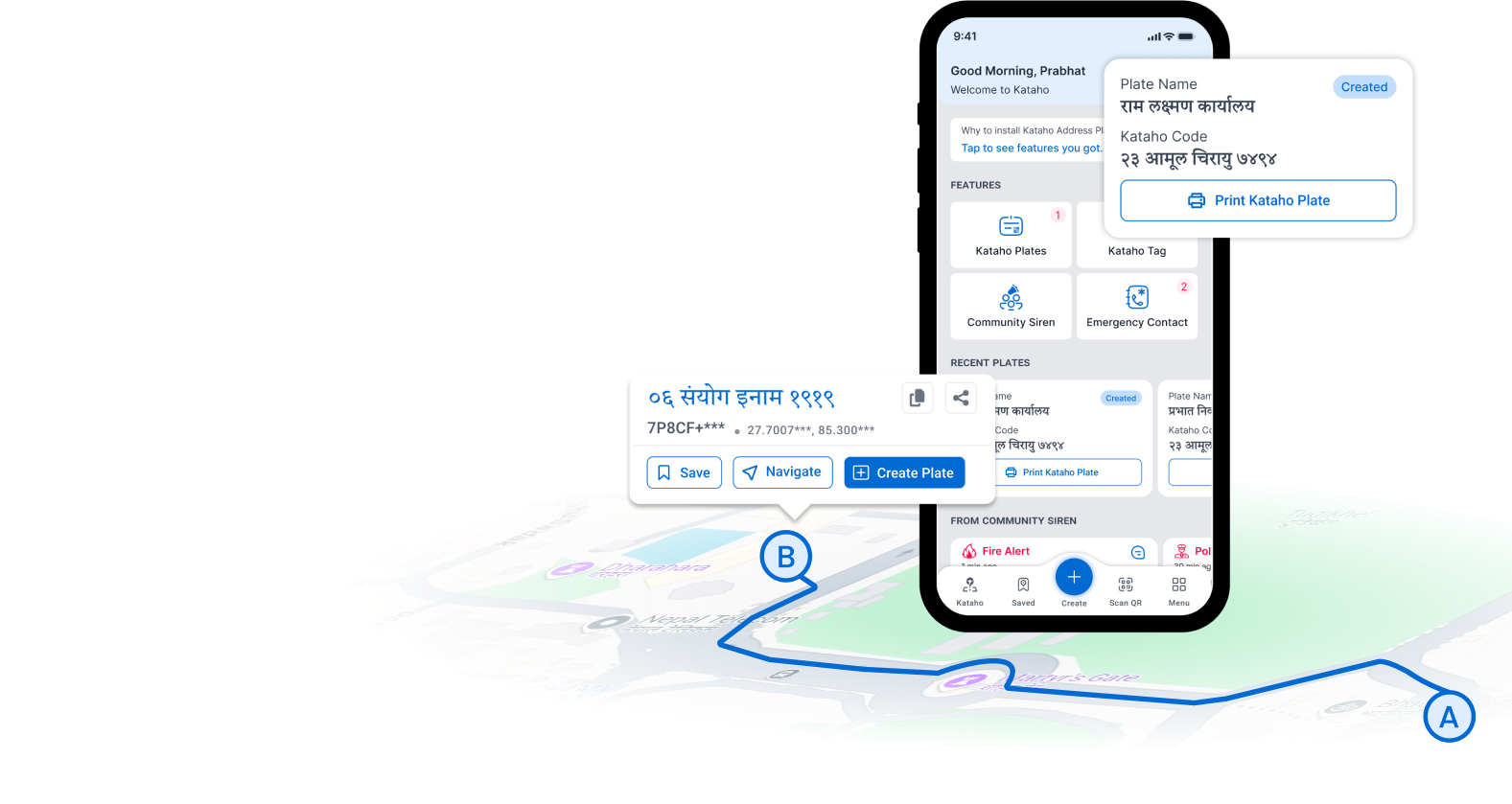
Use Cases of Smart Address Plate & Kataho Addressing
1. Smart Address Plate
• Scenario: A household installs a secure digital address plate to uniquely identify their property.
How it Works:
- The plate is linked to a unique Kataho code and property profile.
- Anyone can scan or enter the code to open verified navigation and details.
• Impact: Gives every property a secure, standardized digital identity.
2. Effortless Address Sharing
• Scenario: A user shares their exact address with a friend, guest, or delivery rider instantly.
How it Works:
- User shares a single Kataho code via any messaging platform.
- Receiver opens the code to get pin-point navigation without confusion.
• Impact: Removes complex directions and reduces wrong-location visits.
3. Virtual Ring Doorbell
• Scenario: A visitor arrives but there is no physical doorbell or the house is hard to access.
How it Works:
- Visitor sends a digital ring/notify request through the Kataho address profile.
- Homeowner receives instant alert and can respond or guide them.
• Impact: Improves visitor experience without requiring a physical doorbell.
4. Voice Address Sharing
• Scenario: A user shares their exact location on a phone call in under three seconds.
How it Works:
- User reads a short, voice-friendly Kataho code.
- Receiver enters the code to open the verified location instantly.
• Impact: Enables instant, accurate location sharing without maps.
5. Address Verification System
• Scenario: A ward office verifies a resident’s address digitally for official records.
How it Works:
- Authorities validate address details with transparency and audit trails.
- Verification status is updated on the property profile for trusted use.
• Impact: Reduces paperwork and strengthens trusted digital addressing.
6. Unified Property ID (KID)
• Scenario: Utilities and services need one consistent identifier for the same property.
How it Works:
- KID acts as a single standardized ID linked to the Kataho address.
- Service providers exchange records using one property identity.
• Impact: Prevents duplication and enables seamless integration.
7. Bank KYC Verification
• Scenario: A bank verifies customer address online without manual maps or field visits.
How it Works:
- Customer shares Kataho code as digital proof of address.
- Bank validates using verified property profiles and status.
• Impact: Cuts KYC time and cost while improving accuracy.
Use Cases of Smart Services & Integrations
8. Logistics & Courier Integration
• Scenario: A user orders online and wants fast, error-free doorstep delivery.
How it Works:
- User provides Kataho code as the delivery address.
- Courier navigates directly to the verified location with fewer calls and delays.
• Impact: Speeds up deliveries and reduces failed drop-offs.
9. Photo Geo-Tagging
• Scenario: A delivery or inspection needs trusted proof that work happened at the right location.
How it Works:
- Capture a geo-tagged photo linked to the Kataho address.
- System generates verifiable evidence for audits and disputes.
• Impact: Builds trust and reduces disputes with location-backed proof.
10. Ride-Sharing Integration
• Scenario: A user books a ride and wants the driver to reach the exact pickup point.
How it Works:
- User shares Kataho code as pickup/drop location.
- Driver opens verified address for accurate navigation and arrival.
• Impact: Reduces cancellations and wrong pickups.
11. Telecom & ISP Enablement
• Scenario: ISP teams install service and handle faults using precise location-based addressing.
How it Works:
- Technicians locate premises using Kataho codes and log assets/installation.
- Fault reports include verified address and evidence for quick resolution.
• Impact: Improves service delivery and speeds up fault resolution.
12. Police & Security Response
• Scenario: A citizen reports an emergency and responders must reach the exact spot quickly.
How it Works:
- Citizen shares a short Kataho code via call or message for immediate location access.
- Teams navigate to the verified address with guaranteed accuracy.
• Impact: Improves response speed and strengthens public safety.
13. Urban Planning Infrastructure
• Scenario: Government uses verified property-level data to plan utilities, roads, and services.
How it Works:
- Kataho provides structured, country-wide addressing linked to properties and services.
- Authorities analyze verified locations to plan investments and track coverage.
• Impact: Enables data-driven governance and smarter urban development.
